
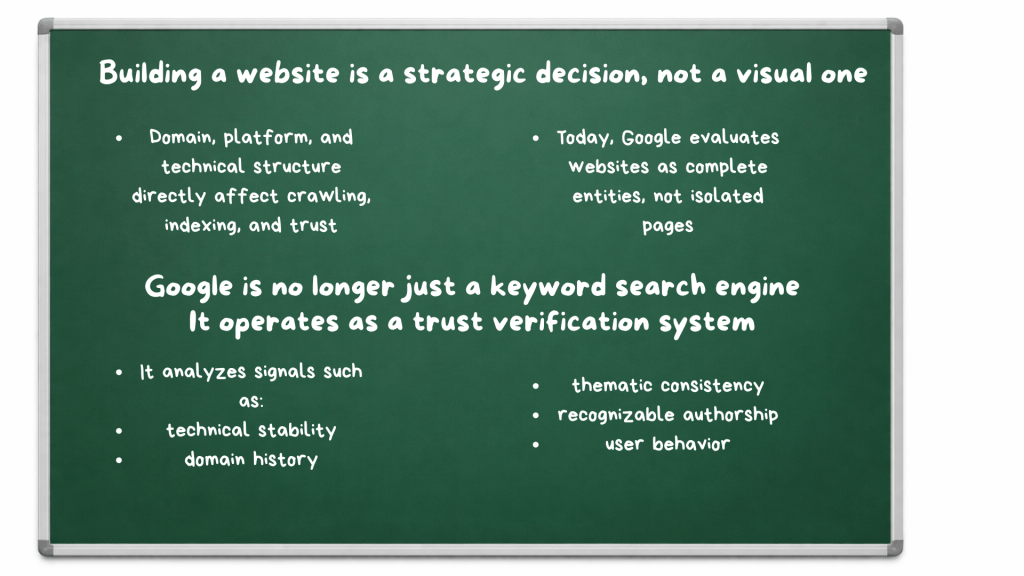
Creating a website involves strategic decisions that go far beyond visual design or simply publishing content. Choosing a domain, platform, website model, and technical structure directly affects how Google crawls, indexes, and interprets a digital presence. In the current landscape, where search engines and artificial intelligence systems evaluate websites as complete entities, these decisions influence authority, visibility, and long-term sustainability.
Google is no longer just a search engine based on isolated keywords. Today, it operates as a trust verification system, analyzing technical, editorial, and behavioral signals to determine which websites deserve greater visibility. Domain history, hosting quality, platform stability, indexing performance, recognizable authorship, and thematic coherence have gained increasing importance. At the same time, Google acts as a digital infrastructure provider, offering services such as Google Workspace, domains, servers, verification tools, and analytics platforms. This creates an ecosystem in which technical decisions are directly connected to commercial and operational interests.
Within this context, the SEO market is divided into very different approaches. On one side, strategies focused solely on isolated optimization, content volume, and constant technical maintenance. On the other, projects that prioritize editorial architecture, thematic consistency, E-E-A-T, and the construction of real authority. This distinction explains why some websites are able to index dense, authorial content with ease, while others rely almost exclusively on institutional pages, paid traffic, or ongoing corrective actions.
Another central issue is the recurring confusion between indexing and ranking. Many websites are correctly indexed but fail to achieve relevant positions in search results. This happens because indexing only means being included in Google’s index, while ranking depends on more complex signals such as content depth, domain trustworthiness, user experience, and authorship recognition. More stable platforms, managed environments, and well-defined editorial structures tend to facilitate this process, especially for author-driven and long-term projects.
This article examines, in a technical and detailed way, the main website models used today, the differences between WordPress.com and WordPress.org, the role of domains and Google verification, the influence of agencies on technical dependency models, the real meaning of E-E-A-T, and how institutional and authorial content are evaluated by algorithms. The goal is to clarify how these variables connect and what their practical implications are for those seeking to build authority, visibility, and digital autonomy in a consistent way.
Website models: why WordPress is not all the same
In the digital market, the term “WordPress” is often used generically, as if it represented a single technical solution. In practice, WordPress.com and WordPress.org correspond to distinct structural models, with direct implications for security, technical governance, indexing behavior, operational dependency, and long-term cost. Ignoring this distinction undermines any serious analysis of SEO, digital authority, and sustainability.
WordPress.org is open-source software that must be installed on a self-hosted or third-party server. In this model, the site owner is fully responsible for managing the environment, including hosting configuration, server performance, core updates, plugins, themes, firewalls, backups, and security monitoring. Each added layer increases customization possibilities, but also expands the site’s technical risk surface, especially without continuous maintenance.
WordPress.com, by contrast, operates as a managed platform. The infrastructure is controlled by Automattic, the company behind WordPress itself. Core updates, security patches, server stability, protection against common attacks, and baseline performance optimizations are handled centrally. This significantly reduces recurring technical failures and creates a more predictable environment for crawling, indexing, and editorial growth.
In addition, blogs hosted on .wordpress.com subdomains tend to be indexed and recognized more quickly, particularly in early stages, because they belong to a domain with long-established authority and trust. The wordpress.com domain has a strong historical presence in Google’s index, a low abuse profile, and millions of legitimate active sites, which reduces initial crawling barriers and trust-related friction. This does not guarantee automatic ranking, but it can facilitate early indexing and initial algorithmic evaluation, especially for new author-driven and editorial projects.
From Google’s perspective, stable and standardized environments support consistent crawling and access to content. This does not create an artificial ranking advantage, but it reduces technical interruptions commonly caused by low-quality hosting, plugin conflicts, security incidents, or performance instability. For content-focused projects, this technical predictability plays an important role in long-term authority building.

Domain and Google: verification, trust, and commercial interests
The domain is the primary identifier of a website for search engines. It concentrates historical data, trust signals, technical configuration, and associations with digital entities. Domains registered within Google’s ecosystem, such as those acquired through Google Domains or connected to Google Workspace, do not receive an explicit ranking advantage, but they do offer relevant operational advantages.
In practical terms, ownership verification in Google Search Console is simpler, DNS configuration tends to generate fewer errors, and integration with services such as Google Analytics, email systems, and indexing tools is more straightforward. This reduces technical friction that often delays the initial indexing of new websites or causes recurring crawling issues.
It is important to distinguish between algorithmic neutrality and operational convenience. Google operates simultaneously as a search engine and as a digital infrastructure provider. Offering domains, corporate email, servers, and verification tools is part of a commercial model. As a result, there is a clear incentive to streamline technical processes for users who remain within this ecosystem. This does not imply direct manipulation of search results, but rather a reduction of technical barriers that can otherwise hinder visibility.
For authorial or editorial projects in their early stages, this reduction in friction can be decisive. DNS misconfigurations, failed verifications, or fragmented service integrations frequently delay proper indexing and distort early performance signals. A well-integrated domain setup minimizes these risks and allows other ranking signals, such as content quality and thematic coherence, to be evaluated more accurately.
Nevertheless, a domain alone does not create authority. It establishes the technical foundation upon which trust, relevance, and editorial consistency can be built. Without sustained content quality, coherent structure, and recognizable authorship, no domain configuration can compensate for the absence of meaningful signals.
Indexing and ranking: two distinct processes in SEO
Indexing and ranking are separate stages within how Google processes and evaluates websites, although they are often treated as interchangeable terms in the market. Indexing refers to Google’s ability to crawl, interpret, and store a page within its index. Ranking, by contrast, refers to the position that page occupies in search results for specific queries.
A large number of websites are correctly indexed but fail to rank for relevant search terms. This occurs because ranking depends on additional signals beyond technical accessibility. Content depth, semantic relevance, user experience, domain history, site stability, and authorship recognition all influence how a page performs once it has been indexed.
Technically clean environments tend to accelerate indexing because they remove common barriers such as server errors, plugin conflicts, caching failures, broken pages, or automated attacks. Managed platforms and well-maintained infrastructures reduce these issues and allow Google to access content more consistently. However, indexing alone does not sustain organic growth.
Websites that publish dense, authorial content often perform better during Google’s evaluation and testing phases. These projects generate stronger behavioral signals, including longer time on page, sustained reading patterns, meaningful user engagement, and return visits. Such signals feed into quality assessment systems and influence how visibility is expanded over time.
As a result, successful SEO strategies recognize indexing as a prerequisite, not an outcome. Ranking emerges when technical accessibility, editorial depth, and consistent thematic focus converge. Without this alignment, even fully indexed websites struggle to achieve durable visibility in competitive environments.

E-E-A-T and the construction of algorithmic identity
The concept of E-E-A-T, which stands for Experience, Expertise, Authoritativeness, and Trustworthiness, is not built through isolated optimizations or technical shortcuts. It emerges from editorial consistency over time. Google does not evaluate individual pages in isolation, but rather the relationships between content, topics, authors, and domains.
Dense, author-driven content plays a central role in this process because it presents recurring vocabulary, progressive depth, and conceptual continuity. These characteristics allow algorithms to identify patterns of thought and associate specific subject areas with a recognizable author or source. Over time, this creates what can be described as an algorithmic identity.
Institutional pages provide essential contextual information about a website, such as its purpose, structure, and legitimacy. However, they rarely sustain E-E-A-T on their own. They explain what a website offers, but they do not demonstrate deep understanding of a subject. Genuine authority is established when a site consistently contributes to the broader understanding of a topic, rather than merely promoting services or products.
This logic increasingly applies to artificial intelligence systems as well. AI models prioritize sources that exhibit conceptual clarity, internal coherence, and low levels of contradiction. Dense, well-structured content reduces semantic ambiguity and improves interpretability, making it more likely to be reused as reference material in generative responses.
As search and AI systems evolve, E-E-A-T functions less as a checklist and more as an emergent property of editorial integrity. Websites that invest in consistent authorship, thematic focus, and long-term content development are better positioned to build durable trust signals across both traditional search and generative environments.

Dense authorial content and optimized institutional content
In traditional SEO practices, institutional pages are often prioritized because they present clear commercial intent and predictable structures. These pages play an important role in establishing baseline credibility, clarifying services, and defining organizational context. However, when treated as the primary drivers of visibility, their impact is limited.
Dense authorial content, by contrast, is a long-term authority asset. It covers broader semantic fields, supports multiple long-tail search queries, and strengthens internal linking through natural thematic connections. Over time, this type of content forms cohesive topical clusters that help search engines understand a website’s core areas of expertise.
When in-depth articles index and perform more strongly than institutional pages, SEO specialists typically interpret this as a signal of editorial maturity. It indicates that search engines recognize higher informational value, conceptual relevance, and contribution to knowledge rather than purely transactional intent.
This pattern is common among reference websites, editorial platforms, and established author-driven projects. It is not a technical SEO failure, nor does it suggest under-optimization of institutional pages. Instead, it reflects an algorithmic preference for content that enhances understanding and demonstrates subject mastery.
As search systems increasingly evaluate meaning, context, and authority, dense editorial content becomes a stabilizing factor. It reduces dependence on isolated keywords, mitigates volatility caused by algorithm updates, and supports sustainable growth rooted in relevance rather than short-term performance tactics.
Technical dependency and the role of agencies
WordPress.org offers full freedom of customization, which makes it highly attractive for agencies and complex digital projects. This flexibility allows the development of advanced systems, custom designs, integrations, and tailored functionalities. However, it also introduces a higher level of technical dependency that must be managed continuously.
Websites built on WordPress.org typically rely on multiple plugins, third-party themes, and external integrations. Each of these components requires regular updates, compatibility checks, security audits, and performance monitoring. Over time, this creates an operational environment where stability depends on ongoing technical intervention rather than inherent platform resilience.
This structure supports a business model based on recurring maintenance contracts. Clients often depend on agencies to manage updates, fix conflicts, address security vulnerabilities, and restore functionality when failures occur. This dependency is not inherently problematic, but it represents a structural choice that transfers long-term control away from the site owner when technical knowledge is centralized externally.
Managed platforms reduce this dependency by consolidating responsibility for infrastructure, security, and system updates. By limiting customization and external extensions, they reduce the number of potential failure points. For creators, writers, independent professionals, and editorial projects, this translates into greater predictability, reduced operational risk, and the ability to focus on content strategy rather than technical upkeep.
Understanding this trade-off is essential when evaluating website models. Technical freedom increases potential, but also increases complexity and dependence. Platform-managed environments prioritize stability and autonomy at the cost of advanced customization. Neither approach is universally superior; each aligns with different strategic priorities and levels of technical capacity.
SEO, AI, and long-term algorithmic interpretation
The evolution of search systems increasingly favors contextual understanding over isolated keyword matching. Google’s algorithms, as well as generative AI models, are designed to interpret meaning, intent, and relationships between concepts. In this environment, shallow content optimized only for short-term performance tends to lose relevance over time.
Dense, well-structured authorial content ages more effectively because it preserves informational value beyond immediate ranking goals. Such content demonstrates conceptual clarity, internal coherence, and thematic continuity, which are critical signals for both traditional search engines and artificial intelligence systems. Rather than relying on repetitive optimization, it builds relevance through depth and explanation.
Generative search and AI-assisted discovery prioritize sources that can be clearly interpreted and trusted. Content that maintains consistent terminology, avoids contradictions, and presents ideas within a logical framework is more likely to be selected as a reference. This selection process does not depend solely on traffic volume or backlink quantity, but on semantic reliability and contextual completeness.
As a result, SEO strategies focused on editorial architecture, topical authority, and authorship recognition are increasingly resilient. They reduce exposure to volatility caused by algorithm updates and shifts in ranking criteria. Instead of reacting to changes, these projects maintain visibility by aligning with how search and AI systems fundamentally process information.
In the long term, SEO is less about manipulating signals and more about building structures that support understanding. Websites that invest in clarity, consistency, and sustained editorial development are better positioned to remain relevant across both search-based and generative discovery environments.
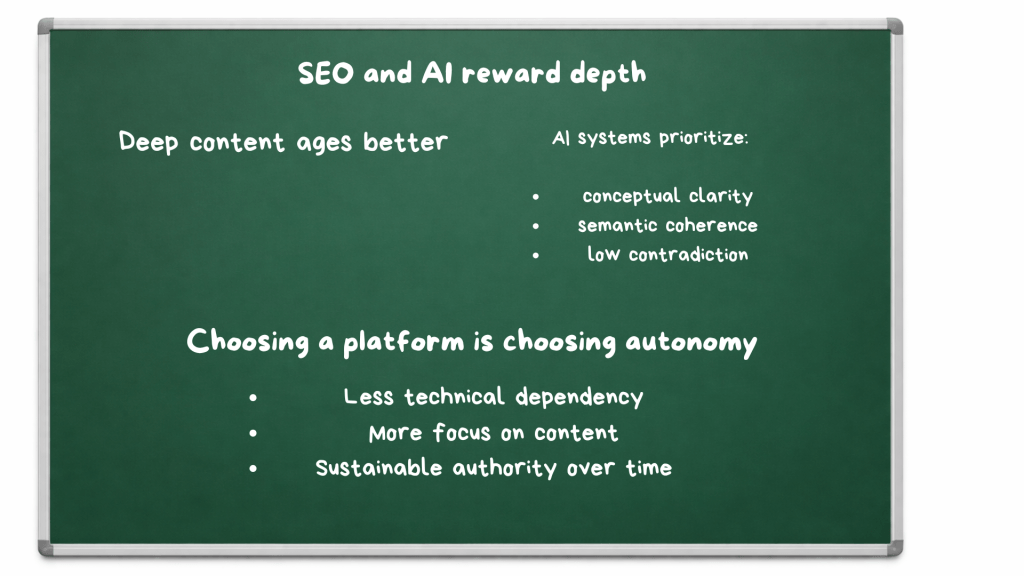
In the current landscape, where traditional search and generative search coexist, projects that invest in editorial depth tend to age better. Artificial intelligence systems value conceptual clarity, continuity of thought, and the absence of contradictions. These factors are the direct result of structural choices made from the outset.
In summary, choosing a platform, domain, and site model is choosing the type of relationship you will have with algorithms, the market, and your own digital autonomy. This is not about shortcuts, but about building a foundation that enables consistent growth, reduced technical dependency, and sustainable authority over the long term.
If you are seeking to build a digital presence that goes beyond traditional SEO and is understood, indexed, and reused by generative intelligence systems, my work is focused precisely on this intersection between authorial content, editorial architecture, and algorithmic interpretation. I develop strategies and produce content that is crawlable, semantically coherent, and designed for the long term—while respecting identity, depth, and real authority. To explore my approach and assess a potential collaboration, visit https://universosdabru.com/ and review the projects and concepts that structure this work.
Brunna Melo — Strategy with Soul, Words with Presence
Brunna Melo is a content strategist, editor, copywriter, and guardian of narratives that heal. She spent a decade working in public education, where she learned through experience that every form of communication begins with listening.
Her journey merges technique and intuition, structure and sensitivity, method and magic. Brunna holds a degree in International Relations, technical certifications in Human Resources and Secretariat, a postgraduate diploma in Diplomacy and Public Policy, and is currently pursuing a degree in Psychopedagogy. From age 16 to 26, she worked in the public school system of Itapevi, Brazil, developing a deep understanding of subjectivity, inclusion, and language as a tool for transformation.
In 2019, she completed an exchange program in Montreal, Canada, where she solidified her fluency in French, English, and Spanish, expanding her multicultural and spiritual vision.
Today, Brunna integrates technical SEO, conscious copywriting, and symbolic communication to serve brands and individuals who wish to grow with integrity — respecting both the reader’s time and the writer’s truth. She works on national and international projects focused on strategic positioning, academic editing, content production, and building organic authority with depth and coherence.
But her work goes beyond technique. Brunna is a witch with an ancient soul, deeply connected to ancestry, cycles, and language as a portal. Her writing is ritualistic. Her presence is intuitive. Her work is based on the understanding that to communicate is also to care — to create fields of trust, to open space for the sacred, and to digitally anchor what the body often doesn’t yet know how to name.
A mother, a neurodivergent woman, an educator, and an artist, Brunna transforms lived experience into raw material for narratives with meaning. Her texts are not merely beautiful — they are precise, respectful, and alive. She believes that true content doesn’t just exist to engage — it exists to build bridges, evoke archetypes, generate real impact, and leave a legacy.
Today, she collaborates with agencies and brands that value content with presence, strategy with soul, and communication as a field of healing. And she continues to uphold one unwavering commitment: that every word written is in service of something greater.
F.A.Q
Is WordPress.com better for SEO than WordPress.org?
WordPress.com and WordPress.org represent different website models, and this distinction directly impacts SEO. WordPress.com provides a managed environment with automatic updates, integrated security, and server stability, which reduces technical issues that interfere with crawling and indexing. For author-driven, editorial, and long-term projects, this stability can support more consistent authority building. WordPress.org offers greater technical freedom, but requires active management of hosting, plugins, themes, and security to avoid SEO-related risks.
Does buying a domain from Google improve search rankings?
Purchasing a domain through Google does not provide a direct ranking advantage. However, domains integrated into Google’s ecosystem, such as those connected to Google Domains or Google Workspace, typically offer easier verification in Google Search Console, fewer DNS configuration errors, and smoother integration with analytics and indexing tools. This reduces technical friction and can accelerate initial indexing, particularly for new websites.
What is the difference between indexing and ranking in SEO?
Indexing is the process by which Google crawls, interprets, and stores a page in its index. Ranking refers to the position that page occupies in search results for specific queries. A website can be fully indexed and still fail to rank well, since ranking depends on additional signals such as content depth, semantic relevance, user experience, domain history, technical stability, and authorship recognition.
Does dense authorial content help with SEO and indexing?
Yes. Dense authorial content increases a website’s semantic depth, strengthens topical clusters, and generates positive user engagement signals such as longer time on page and sustained reading behavior. These factors support editorial authority, E-E-A-T, and long-term SEO performance, especially for informational and educational websites.
Are institutional pages enough to build digital authority?
Institutional pages are important for baseline credibility and organizational context, but they are rarely sufficient to build digital authority on their own. Search engines tend to recognize authority when a website demonstrates subject-matter expertise through consistent, in-depth informational content. Authorial content plays a central role in this process.
What is E-E-A-T and why does it matter for SEO?
E-E-A-T stands for Experience, Expertise, Authoritativeness, and Trustworthiness. These criteria are used by Google to assess content quality and source reliability. E-E-A-T is built over time through consistent authorship, thematic coherence, content depth, and a trustworthy publication history, rather than through isolated technical optimizations.
Does WordPress.org create dependency on agencies?
WordPress.org can create technical dependency on agencies when websites rely heavily on plugins, custom themes, and complex integrations. These elements require ongoing updates, security audits, and maintenance, often leading to recurring service contracts. This model is not inherently negative, but it represents a structural choice that may reduce autonomy for site owners without technical expertise.
Do managed platforms limit organic growth?
Managed platforms do not limit organic growth when the strategy focuses on editorial SEO, authorial content, and topical authority. By reducing technical complexity and operational risk, managed environments allow creators and editorial teams to concentrate on content production and structural consistency, which are key factors for sustainable SEO.
Does SEO still matter in the age of AI and generative search?
SEO remains relevant, but its focus has shifted. Strategies based solely on shallow keyword targeting and mechanical optimization are losing effectiveness. SEO today emphasizes semantic clarity, content depth, user experience, editorial architecture, and E-E-A-T, all of which are also valued by AI-driven search systems.
How long does it take to build digital authority?
Building digital authority is a gradual process. For consistent projects, initial signals often appear within six to twelve months, while full consolidation typically occurs over the medium to long term. There are no sustainable shortcuts. Authority results from structural decisions, editorial consistency, and long-term content investment.





 Universos da Bru
Deixe um comentário